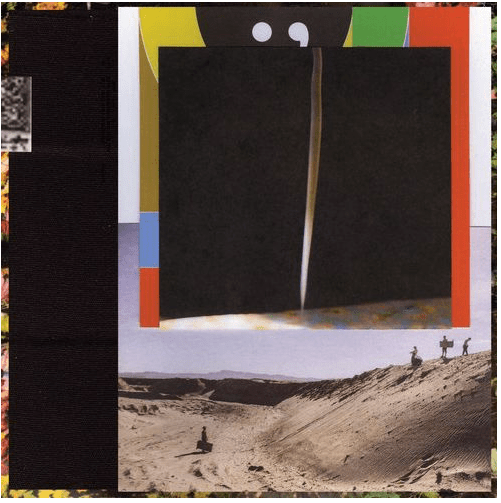
Justin Vernon, the mystical heart and soul of the band Bon Iver, has retroactively painted his first three, and now four, albums as inspired and influenced by the seasons. The frigid winter of For Emma, Forever Ago, the hot summer of 22, A Million, the lush fall of Bon Iver, Bon Iver, and now the glorious spring of i,i.
The new album has themes of reawakening, of exposing oneself to light, of truth and its many forms. The record is long and loose and rabid with ideas.
It’s not as strong a showing as his previous album, 22, A Million, which surprised me and became my favorite album of 2016, beating out a near-perfect Radiohead record. Whereas 22AM was very cohesive, especially in texture, Justin’s signature voice hidden in waves of digital manipulation, here his naked falsetto sours on songs like “Naeem” and “Faith.”
The album exists in three disparate parts. The opening tracks are reminiscent of the electronics in the previous album and the modern hip-hop influences of Justin’s recent work. Songs like “iMi” and the fantastic “We” mash up various styles, all conjoined by a kind of word-salad approach to lyrics. Bon Iver’s early work was defined by stark poetry told over dramatic music, as such there were less words to work with, but those that were there stood as memorable (“I was not magnificent.”) Here, Justin is using his voice as another layer, jumbling words and sentences that don’t make a lot of sense (at least in my mind), but do leave lingering imagery that informs the music. It’s symbiotic and doesn’t always work (see: the skip-able “Hollyfields,”).
The middle, and best, part of the record has the one-two punch of early singles “Hey Ma” and “U (Man Like).” Both songs are remarkable in their skill. “Hey Ma” reminds me of the strength of “33 (God)” from the last record, but without the dramatic flourish climax. It’s a deeply personal story, from what I can gather, with a memorable if simple chorus: “Tall time to call your Ma. Hey Ma! Hey Ma!” The second song in the quartet, “U (Man Like)” is built on an incredible piano figure written by the singer-songwriter Bruce Hornsby, and contains Justin at his most melodic and employs a small gaggle of other singers to compliment the melodies
The high-flying “Naeem” follows. It’s probably the best song on the record, it’s all emotion and that driving drumbeat at the end is awesome. Justin practically cries as he sings, “well I won’t be angry long, WELL I CAN’T BE ANGRY LONG.”
“Jelmore” feels like a transitional song and is thus a little too long.
“Faith” caps the middle part of the record. i,i is an album with a lot of say, (although none of it is very clear), but it is ambitious and contains songs of all different shapes and lengths, as if the band is playing with form as well as sound. “Faith” feels like the one piece on the record with a defined beginning, middle, and end. It doesn’t hurt that it sounds like it could be something off his seminal self-titled record. When that chorus and strings show up, it’s hard not to feel emotionally swept up in whatever the heck he’s singing about.
The final part of the record is the most muddled. There’s sparks of brilliance in the last four songs on the album, but the overall effect is lost as the band seems to wander from detour to detour in search of meaning. The one bright spot is the sublime “Salem,” with its playful wordplay and charming alliteration.
I’m conflicted on a overall summation of this wild ride of a record. I’ve long subscribed to the theorem that some music is “Expert-level” and requires a deep dive into it, born of repeated listening in various states of mind. It’s the idea that in order to understand some music, you need to put yourself into the mindset of the creators. This album, like its predecessor, demands that time and attention, but is there a reward at the end of that journey? For me, the last album did provide that catharsis after diving full throated into it. I’m not sure if this album, despite its obvious strengths, has the depth that will reward that effort.
 Elad Haber